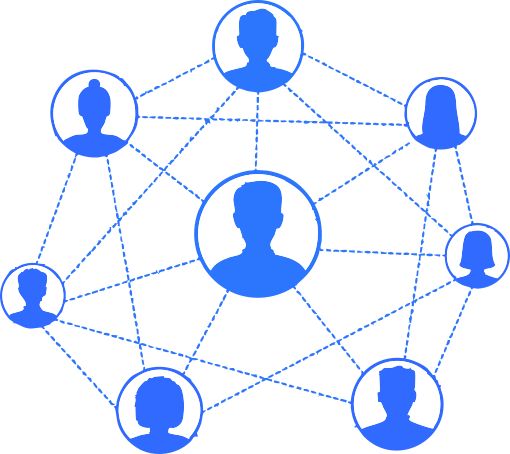
The collection brings together introductory materials and applied studies on the use of Social Network Analysis (SNA) in criminal investigations. It presents the theoretical foundations, methods, and metrics used to map connections between individuals and organizations, identify strategic targets, and uncover points of vulnerability within criminal structures. This approach integrates insights from sociology, mathematics, and criminology, supporting evidence-based law enforcement actions and strategic decision-making.
The collection brings together introductory materials and applied studies on the use of Social Network Analysis (SNA) in criminal investigations. It presents the theoretical foundations, methods, and metrics used to map connections between individuals and organizations, identify strategic targets, and uncover points of vulnerability within criminal structures. This approach integrates insights from sociology, mathematics, and criminology, supporting evidence-based law enforcement actions and strategic decision-making.
Civil Police Officer in the State of São Paulo since 2013, with experience in the investigation of cybercrimes, fraud, and organized crime. Holds a degree in Computer Engineering and a Bachelor’s in Information Technology from UNIVESP, as well as a Bachelor’s in Law from FEMA. She is a Specialist in Criminal Law and Criminal Procedure (Estácio de Sá University), Organized Crime (National Police Academy), and Data Analysis (FaCiência). She is currently pursuing a specialization in State and Police Intelligence (Gran Cursos) and in Public Security Management (Federal University of Mato Grosso do Sul).
A researcher at the University of São Paulo (USP), she develops studies on the application of Social Network Analysis to criminal investigations, focusing on the identification of high-topological-return targets and on graph structuring for the understanding of criminal organizations. She has presented work at national and international conferences on cybercrime and criminal analysis. She also teaches in the field of data science, with experience in programming logic and data analysis applied to public security.
Social Network Analysis (SNA) is an important tool in criminal analysis, as it enables a deeper understanding of criminal structures, the identification of strategic targets, and the detection of vulnerable points within criminal organizations, thereby contributing to more efficient and focused police interventions.
Although the term “Social Network Analysis” (SNA) might suggest a study of digital platforms such as Facebook, Instagram, or X, this assumption is incorrect.
SNA refers to the study of relationships and interactions among individuals, groups, or entities, regardless of digital platforms.
SNA refers to the study of relationships and interactions among individuals, groups, or entities, regardless of digital platforms.
It is a scientific approach to understanding the structures and patterns of social connections. This field emerged from the inherent human need and curiosity to understand human behavior. To fully grasp its application, we must first revisit its historical development.
In the 1930s, sociometry emerged as a new field that revolutionized the study of social behavior. Before this period, disciplines such as psychology, anthropology, and sociology had addressed the subject, but with sociometry, the exact sciences began to participate directly in the analysis of human relationships. The term sociometry derives from the Latin socius (social) and metrus (measure), reflecting its proposal to measure and understand group organization and the positions individuals occupy within networks. Jacob Moreno was one of its pioneers, emphasizing the importance of social interactions and their measurement.
While individual behavior is unpredictable, behavior in groups becomes measurable and predictable.
Gustave Le Bon, a contemporary of Freud, explored mass psychology and demonstrated how groups develop collective personalities distinct from those of their individual members. Regardless of why people gather—family, friendship, work, shared interests—a collective personality emerges that supersedes individual traits.
In other words, in social interactions, 1 + 1 is not exactly equal to 2. At this point, applying metrics becomes useful to quantify relationships and assign mathematical values to interactions and the positions of agents within a network.
It is important to stress that Social Networks, in this context, refer to a system of relationships among people, organizations, or objects that share some type of connection. To make this analysis visible, graphs are used to represent individuals and their interconnections.
Graph theory has its origins in the Seven Bridges of Königsberg problem, an eighteenth-century mathematical challenge. The city was divided by a river and connected by seven bridges. The question was whether it was possible to cross all the bridges without repeating any path. Mathematician Leonhard Euler proved that such a route was impossible, as each connected area would need to have an even number of bridges. This problem led to the development of graph theory, which is now fundamental not only for visual representation but also for the application of quantitative metrics in SNA. These metrics allow analysts to quantify interactions and identify structural patterns. Key metrics include:
Degree: measures how many connections a node has within the network, which may consider direction (in-degree and out-degree).
Clustering: evaluates groups and subgroups within the network, identifying interconnected communities.
Betweenness Centrality: identifies individuals who function as bridges of information and play a key role in dissemination.
Closeness Centrality: measures how close, on average, an individual is to all others.
PageRank: a concept based on Google’s algorithm that evaluates the relevance of a node based on the number and influence of its connections.
SNA has direct connections with criminology. Edwin Sutherland’s Differential Association Theory is closely aligned with SNA, as it asserts that criminal behavior is learned through social interaction. According to this theory, an individual becomes criminal to the extent that they are exposed to definitions favorable to violating the law in greater proportion than to definitions unfavorable to such violations. In this sense, criminal networks are formed and maintained through interactions, making SNA essential for mapping these connections and enabling effective intervention.
In criminal analysis, SNA supports the understanding of criminal structures, helps identify strategic targets, and reveals vulnerable points within criminal organizations. By applying its metrics, it is possible to detect individuals with high connectivity and betweenness who exert significant influence over the criminal network. SNA also makes it possible to anticipate communication and collaboration patterns among members of organized crime. This methodology has been used to identify High Topological Return Targets—individuals whose removal causes the greatest structural impact on the criminal network. This concept was introduced in Brazil by Bruno Requião da Cunha, who demonstrated through research and practical examples that SNA can optimize criminal investigations, offering a systemic view of crime and supporting strategic decision-making to dismantle criminal organizations.
SNA is also widely employed across different fields, including:
Today, SNA has specialized journals, international conferences, and integration across multiple academic and professional disciplines. Its impact continues to expand, establishing it as an essential tool for understanding complex social dynamics and improving security and efficiency across different sectors.
In the materials listed in the bibliography, readers can explore the topic in greater depth and observe its practical applications beyond theoretical boundaries.